Why Your Bank Balance Doesn’t Match Net Profit | Booktied
June 22nd, 2026 Posted by Aidy Schreiber Blog, Bookkeeping Tips 0 thoughts on “Why Your Bank Balance Doesn’t Match Net Profit | Booktied”Wondering why your bank balance does not match your net profit? Learn the difference between cash flow, net income, accounts receivable, loan payments, inventory, and owner’s draws.
One of the most common questions business owners ask is:
“Why doesn’t my bank balance match my net profit?”
You look at your profit and loss statement and see that your business made money. Then you check your bank account and the cash balance tells a completely different story.
So where did the money go?
The answer is simple:
Your bank balance and your net profit are not the same thing.
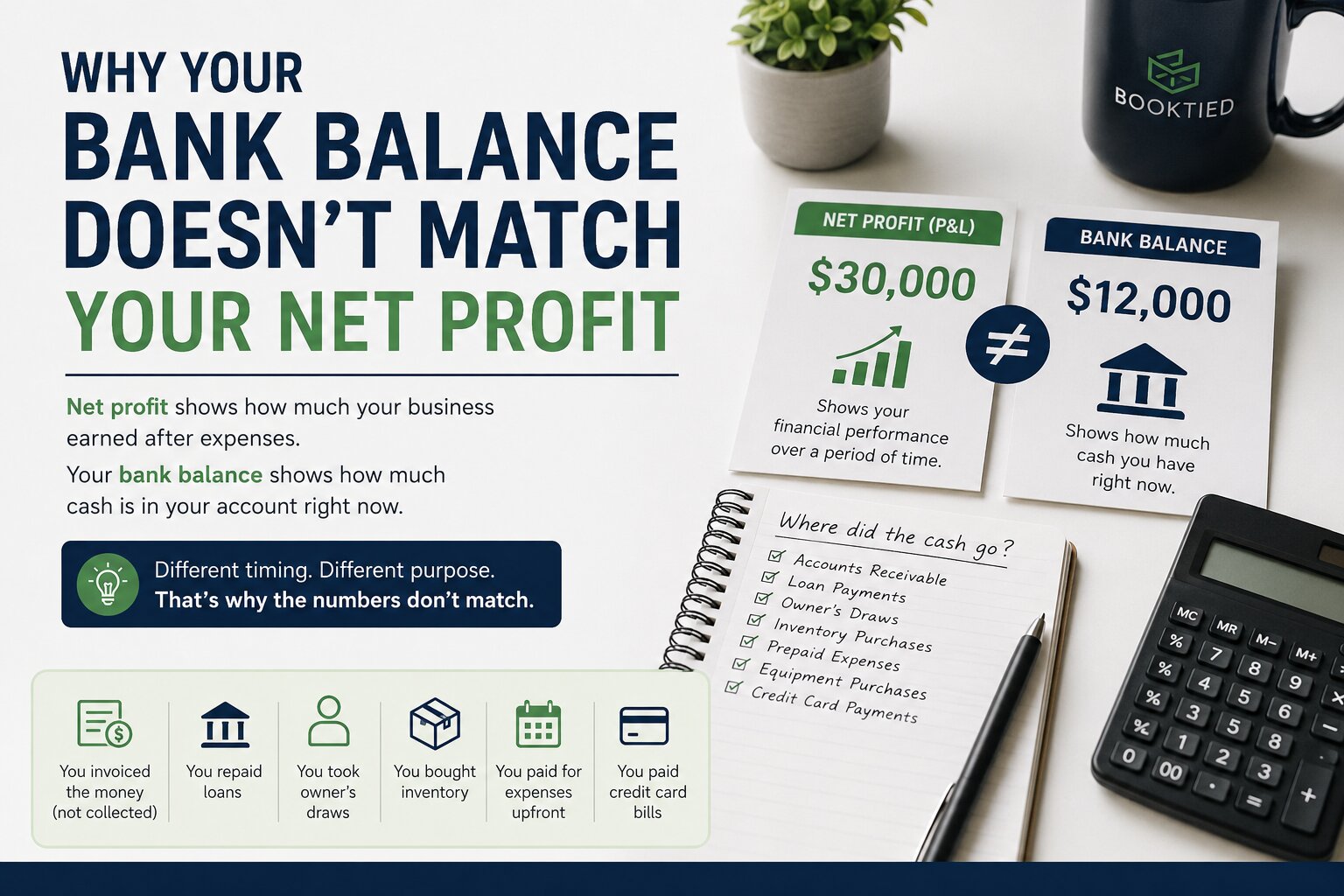
Net profit shows how much your business earned after expenses.
Your bank balance shows how much cash is actually sitting in your account right now.
Those two numbers are connected, but they usually will not match exactly.
What Is Net Profit?
Net profit, also called net income, appears on your profit and loss statement.
It is the amount left after subtracting business expenses from income.
A basic example:
Revenue: $100,000
Expenses: $70,000
Net Profit: $30,000
That means your business earned $30,000 in profit.
But that does not mean your bank account increased by $30,000.
This is where many business owners get confused.
What Is Bank Balance?
Your bank balance is the actual amount of cash in your business bank account.
It changes when money comes in or goes out.
But not every cash movement shows up on your profit and loss statement.
And not every profit and loss transaction changes your bank balance right away.
That is why your bank balance and net income often look different.
Why Bank Balance and Net Profit Don’t Match
There are several common reasons your bank balance does not match your net profit.
Some are related to timing.
Some are related to cash flow.
Some are related to the balance sheet.
Here are the biggest ones.
1. Accounts Receivable: You Earned It, But Didn’t Collect It Yet
Accounts receivable is one of the most common reasons net profit and cash do not match.
Let’s say you completed a job and invoiced a customer for $10,000.
If your books are on an accrual basis, that income may show on your profit and loss statement.
But if the customer has not paid yet, the money is not in your bank account.
So your P&L may show profit, but your bank balance does not reflect the cash yet.
That money is sitting in accounts receivable.
2. Loan Repayments: Cash Leaves, But Principal Is Not a P&L Expense
Loan payments can also make your bank balance look lower than your net profit.
When you pay a loan, the payment usually has two parts:
Interest
Principal
The interest portion is usually an expense on the profit and loss statement.
The principal portion is not a P&L expense. It reduces the loan balance on your balance sheet.
So cash leaves your bank account, but your net income does not go down by the full payment amount.
This is a major reason a profitable business may still feel tight on cash.
3. Owner’s Draws: Money Out, But Not a Business Expense
Owner’s draws reduce the cash in your bank account, but they usually do not reduce net profit.
For example, if your business made $80,000 in net profit and you took $50,000 in owner’s draws, your P&L may still show $80,000 in profit.
But your bank account will show that $50,000 left the business.
Owner’s draws affect cash.
They do not show as regular business expenses on the P&L.
4. Inventory Purchases: Cash Goes Out Before the Expense Shows Up
Inventory is another common reason your bank balance and net profit do not match.
When you buy inventory, cash leaves the business right away.
But the inventory may not be expensed immediately.
Instead, it is usually recorded as an asset on the balance sheet. The expense is recognized later through cost of goods sold when the inventory is sold.
That means your bank balance can drop today, even though your profit and loss statement does not show the full expense yet.
5. Prepaid Expenses: Paid Now, Expensed Later
Prepaid expenses can also create a difference between cash and profit.
Examples include:
Insurance
Rent
Software
Subscriptions
Annual service contracts
You may pay for something upfront, but the expense may be spread over several months.
So the cash leaves your bank account immediately, while the expense hits your P&L over time.
6. Equipment and Large Purchases
Large purchases, such as equipment, vehicles, computers, or machinery, can affect cash without fully hitting your profit and loss statement right away.
You may spend a large amount of cash upfront.
But instead of recording the entire purchase as an immediate expense, the item may be recorded as an asset and depreciated over time.
This means your bank account decreases now, while your net profit may only show part of the cost.
7. Credit Card Payments: Paying the Bill Is Not Always a New Expense
Credit card payments can be confusing.
When you pay your business credit card, cash leaves your bank account.
But the expenses may have already been recorded when the credit card charges were entered.
In that case, the credit card payment is not a new expense.
It is simply paying down a liability.
So your bank balance goes down, but your net profit does not change at that moment.
Why the Profit and Loss Statement Is Not Enough
Many business owners focus only on the profit and loss statement.
The P&L is important, but it does not tell the full financial story.
Your P&L tells you whether your business was profitable.
But it does not always explain where the cash went.
To understand the difference between bank balance and net profit, you also need to review your balance sheet and cash flow statement.
The Balance Sheet Explains Where the Money Is
Your balance sheet shows what your business owns and owes.
Accounts receivable
Inventory
Loans
Credit cards
Owner’s equity
Prepaid expenses
Equipment
Other assets and liabilities
If your business is profitable but cash feels low, the answer is often hiding on the balance sheet.
The Cash Flow Statement Shows Where the Money Went
Your cash flow statement helps explain how cash moved through your business.
It can show whether cash was used for:
Operating expenses
Inventory
Loan payments
Equipment purchases
Owner distributions
Debt repayment
This is why cash flow reporting is so important.
A business can be profitable and still have cash flow problems.
Profit vs. Cash Flow: Simple Difference
Here is a simple way to understand it:
Net profit answers:
“Did the business make money?”
Bank balance answers:
“How much cash do I have right now?”
Balance sheet answers:
“What does the business own, owe, and have tied up?”
Cash flow statement answers:
“Where did the money actually go?”
You need all of these reports to understand the real financial position of your business.
Example: Profitable Business, Low Bank Balance
A business owner may look at the P&L and see $50,000 in net profit.
But the bank account may only have $12,000.
That difference could be because:
$15,000 is still unpaid in accounts receivable
$10,000 went toward loan principal
$8,000 was taken as owner’s draws
$5,000 was spent on inventory
$3,000 was prepaid for insurance
The business may still be profitable.
But the cash moved somewhere else.
That is why looking only at the bank balance can be misleading.
Why Clean Bookkeeping Matters
Clean bookkeeping helps business owners understand the difference between profit and cash.
Without accurate books, it is hard to know whether the issue is:
Low profitability
Slow collections
Too much inventory
High loan payments
Owner draws
Missing transactions
Poor cash flow management
When your books are clean, you can stop guessing.
You can see what actually happened.
Final Thoughts: Your Bank Balance and Net Profit Are Supposed to Be Different
Your bank balance and net profit usually will not match exactly.
That does not automatically mean something is wrong.
It may simply mean cash is tied up in accounts receivable, inventory, loan repayments, owner’s draws, prepaid expenses, or other balance sheet items.
But you should know why they are different.
That is where proper bookkeeping makes a big difference.
At Booktied, we help business owners get clean, accurate books so they can understand their numbers, improve cash flow, and make better financial decisions.
Because profit matters.
But knowing where the money went matters just as much.